
Let me be direct with you.
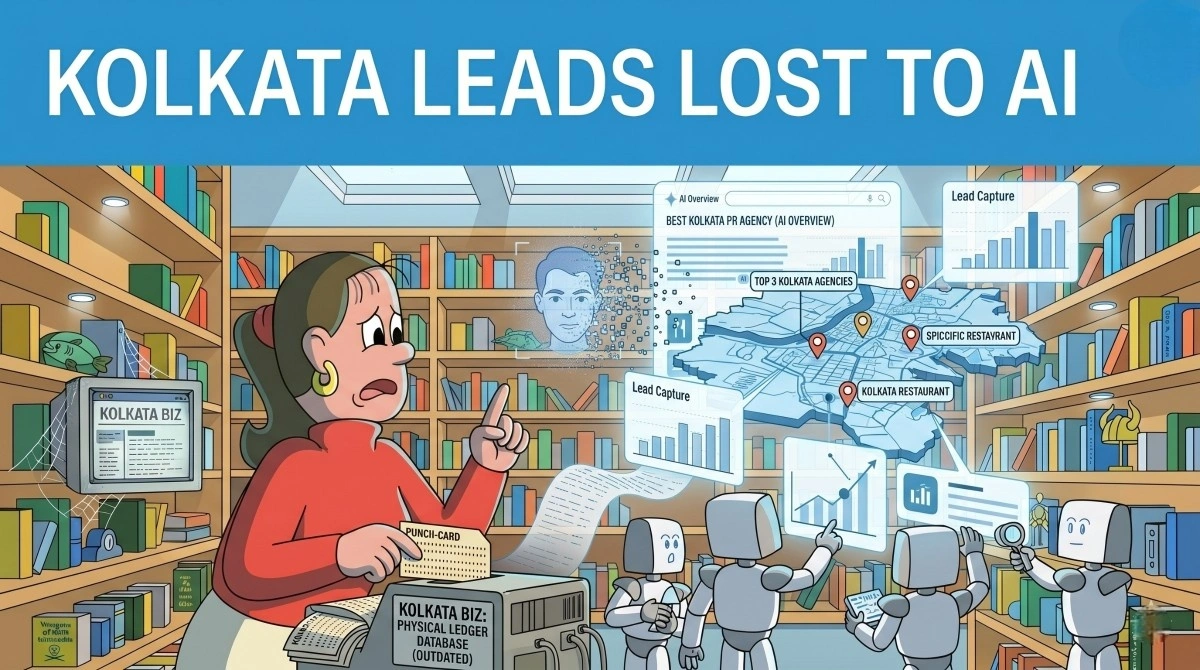
If your Kolkata business has a website that was built more than two years ago and nobody has seriously updated it since, you are probably losing leads right now. Not because your product is bad. Not because your brand isn't good. But because the way people find businesses like yours has fundamentally changed, and your website wasn't built for this new world.
I'm talking about AI-powered search, Google's AI Overviews, voice assistants, and conversational tools like Perplexity and ChatGPT. These are now the first stop for most purchase decisions. And the websites they recommend? They aren't the prettiest. They're the most technically prepared.
In this post, I'll walk you through exactly what's happening, what the data says, and what you can do about it, practically, not theoretically.
1. The Zero-Click Crisis, Your Website Has Already Lost Most of Its Audience
TL;DR More than 60% of Google searches now end without anyone clicking a website. If you are not cited inside Google's AI answer box, you are invisible, no matter what page you rank on.
Here's the number that should worry you: according to research tracking Google search behaviour through 2025,
The data: Approximately 60–65% of Google searches now end without a single click to any external website. For searches that trigger an AI Overview, that zero-click rate jumps to over 80%.
This is called the zero-click search problem, and it has been accelerating rapidly since Google rolled out AI Overviews to everyone in 2024. What this means in plain terms: when someone in Kolkata searches for "best web design company near me" or "chartered accountant Salt Lake Sector V", Google reads several websites, synthesises the answer, and displays it right there. Most users never click past it.
A Pew Research Center study tracking 68,000 real searches found that users clicked on a traditional result only 8% of the time when an AI Overview was present, compared to 15% when no AI summary appeared. That is a 47% reduction in click-through rate.
And if your website isn't cited as a source inside those AI Overviews? You effectively don't exist for that query.
What this looks like for a Kolkata business
Think about a potential client searching for a CA firm in Ballygunge, or a parent looking for a coaching institute near Jadavpur. They type the query. Google's AI gives them a direct answer, with a business name, services listed, maybe even a phone number. If that business name is yours, you win. If it's your competitor who invested in an AI-ready website, you lose, and you won't even know it happened.
✅ Practical Fix: Check if your website is being cited in AI Overviews right now. Open Google, search for your own service + your Kolkata neighbourhood (e.g., 'web design company Salt Lake'). If your business doesn't appear in the AI box at the top, that's the problem you need to fix.
📌 Source: Pew Research zero-click study
📌 Source: SparkToro 2024 zero-click statistics
📌 Source: Zero-click statistics timeline 2026
2. INP, The Speed Metric That Google Quietly Made a Ranking Factor
TL;DR In March 2024, Google replaced its old speed metric with INP (Interaction to Next Paint). A good score is under 200ms. Fail this on mobile and Google demotes you, even if your content is excellent.
Most business owners I talk to know that page speed matters for SEO. What they don't know is that Google changed what speed metric it uses in March 2024, and the new one is far more strict, especially for Indian mobile users.
The metric is called Interaction to Next Paint (INP). It replaced the old First Input Delay (FID) metric as one of Google's three official Core Web Vitals, the performance signals that directly influence search rankings.
What exactly does INP measure?
INP measures the time between a user interacting with your website, tapping a button, clicking a menu, pressing a key, and when the browser visually responds to that action. In other words: how fast does your site actually feel?
The thresholds are:
Under 200ms → Good ✅
200–500ms → Needs improvement ⚠️
Over 500ms → Poor ❌ (Google may demote your ranking)
The critical thing here: INP is measured on real user devices via Google's Chrome User Experience Report (CrUX). This means Google isn't testing your site on the latest iPhone in a lab. It's measuring actual behaviour from real users on their actual phones, including mid-range Android devices on 4G networks, which is exactly the majority of mobile internet users in India.
Why this matters in Kolkata: A potential customer browsing your services from a Redmi phone on a patchy network in Rajarhat or Behala is not having the same experience as you testing it from your office desktop. If your site lags on their device, Google knows, and your ranking suffers for it.
Practical application: how to check and fix your INP
Step 1, Check your current score:
Go to PageSpeed Insights and enter your website URL
Switch to Mobile view and look for the INP score under 'Core Web Vitals'
If you see an orange or red score, this is actively affecting your Google ranking right now
Step 2, The most common causes of poor INP on Indian business websites:
Heavy JavaScript that hasn't been split into smaller chunks
Too many third-party scripts (chat widgets, analytics, ad pixels) loading on every page
Unoptimised images making the browser work too hard to render
Page builders like Elementor or Divi adding excessive CSS and JS bloat
✅ Practical Fix: If your site was built with a drag-and-drop page builder (Elementor, WPBakery, Divi), there's a high chance your INP score is failing. These tools are convenient but notoriously slow on mobile. A developer-built site using Next.js or Astro will perform significantly better. Ask your web agency specifically about their INP scores on mobile India networks.
Industry stat: An Ahrefs audit found only 33% of websites are meeting the Core Web Vitals threshold. That means roughly 2 out of 3 business websites in India, including most in Kolkata, are likely failing this standard.
📌 Source: INP official documentation, Google
📌 Source: INP became a Core Web Vital, Search Engine Land
📌 Source: Only 33% of sites pass Core Web Vitals, RebelMouse/Ahrefs
3. Structured Data & Schema Markup, The Code That Makes AI "Trust" Your Website
TL;DR Schema markup is machine-readable code that tells AI systems exactly what your business does, where it is, and why it's credible. Without it, AI search engines skip your site. With it, they recommend you. Only 30% of websites use it, which means most of your competitors haven't done this yet.
Here's something most business owners, and honestly, a lot of web designers, don't know.
There's a type of code called structured data markup (or schema markup) that lives inside your website's HTML but is invisible to human visitors. Its entire purpose is to tell search engines and AI systems: "This is who we are, what we sell, where we are located, and here are our reviews." It's the language of the machines.
And a September 2025 controlled experiment by Search Engine Land made this crystal clear: three nearly identical pages with the same content and the same keyword difficulty were tested. The only meaningful difference was schema markup. Result: only the page with proper schema appeared in Google's AI Overview. The page with no schema was never even indexed.
The opportunity: Only 30% of websites currently use schema markup (Searchmetrics/Search Engine Land). That means 70% of your competitors, including most businesses in Kolkata, have not done this. If you implement it properly now, you are immediately more visible to AI search than the majority of your market.
What schema types matter most for a Kolkata business?
LocalBusiness, your name, address, phone, hours, and service area. Critical for local search.
Service, describes each service you offer in machine-readable format
Review / AggregateRating, your Google/Facebook ratings made readable to AI
FAQPage, answers common questions your customers ask (note: now restricted to health/govt sites for rich results, but still valuable as an AI trust signal)
BreadcrumbList, helps AI understand your site structure
Organization, your brand, logo, social profiles, founding year
Practical application: how to check if your site has schema
Step 1, Right-click anywhere on your website and select 'View Page Source.'
Step 2, Press Ctrl+F and search for 'application/ld+json'.
If you see nothing, your site has no structured data. That's a serious problem in 2026.
✅ Practical Fix: Use Google's free Rich Results Test tool (search.google.com/test/rich-results) to scan any page of your site. It will show you exactly what schema is present and what's missing. Run it on your homepage and your main services page. If you see zero schema detected, this is almost certainly hurting your visibility in AI search.
The case studies back this up:
Food Network saw a 35% increase in organic visits after implementing structured data
Rotten Tomatoes achieved a 25% higher click-through rate on schema-marked pages
Rakuten found users spent 1.5x more time on structured data pages versus non-structured pages
A brand new golf clothing site with no backlinks, implementing schema from day one, achieved 668,000 impressions and AI Overview citations across its target keywords in just 6 months
📌 Source: Search Engine Land schema controlled experiment (2025)
📌 Source: Schema markup statistics
📌 Source: Schema and AI search visibility 2026
📌 Source: Schema semantic value for LLMs, SchemaApp
4. Agentic Websites, Your Site Needs to Do Things, Not Just Show Things
TL;DR Kolkata consumers, trained by Swiggy, Flipkart, and Zomato, expect instant action from websites. If your site only displays information but can't answer questions, book appointments, or qualify a lead automatically, you are losing to sites that can.
Think about the last time you used Swiggy. You didn't browse a PDF menu and then call the restaurant to place your order. You tapped, chose, and it was done. That expectation of instant action has bled into how people interact with all websites, including yours.
The 2026 shift is this: a website that only displays information is being outcompeted by websites that do things. These are sometimes called agentic websites, sites where the website itself acts as a 24/7 sales and service agent.
What a non-agentic website looks like (most Kolkata sites)
Visitor lands at 11 PM wanting a service quote
Finds a 'Contact Us' form
Fills it out and waits, maybe gets a reply the next day
By then, they've already booked with a competitor whose site answered them in real time
What an agentic website looks like
Visitor lands at 11 PM wanting a service quote
AI-driven chat qualifies the enquiry: service type, budget, timeline
Instantly provides a personalised quote range or books a discovery call
Lead captured, nurtured, and followed up automatically
By morning, you have a qualified appointment waiting in your calendar
Practical application: what to add to your site
WhatsApp Click-to-Chat button, floating, always visible. In the Indian market, this alone can increase enquiry rates by 40–60%. If your site doesn't have this, add it today.
Inline FAQ with schema markup, answer the 5–8 questions every potential client asks before they enquire. This doubles as AI-indexable content.
Booking widget, Calendly, Cal.com, or similar. Let people book a call without emailing you.
Instant quote calculator or scoping tool, even a simple form that returns a price range qualifies the lead and saves you time
Live chat or AI chatbot, doesn't need to be complex. Even a scripted chatbot that routes enquiries properly is better than a static contact form
✅ Practical Fix: Start simple: add a WhatsApp chat button to your website this week. Use the free tool at wa.me to generate your link, then add a floating button using your CMS. Track how many conversations it generates in 30 days vs. your contact form. Most Kolkata businesses see the WhatsApp button become their #1 lead source within weeks.
The Flewny approach: As a specialist web design company in Kolkata, Flewny builds these agentic capabilities into every website we develop, not as add-ons, but as core features from day one.
5. Hyper-Local UX, Why a Template Designed in Delhi Won't Convert in Kolkata
TL;DR The Kolkata buyer is different. They prioritise trust signals, prefer WhatsApp over email, respond to local landmark and neighbourhood references, and a significant portion use mid-range Android devices. A template built for a generic Indian audience will underperform here.
I've seen it enough times to say it directly: agencies that apply the same template to every Indian city, Delhi, Bengaluru, and Kolkata treated identically, are leaving conversions on the table for their Kolkata clients. The cultural and behavioural differences are real.
What the Kolkata buyer actually responds to
Trust before transaction. Kolkata buyers are more trust-sensitive than buyers in most other Indian metros. A physical address, a recognisable Kolkata neighbourhood, client names (with permission), and a photo of your team convert significantly better than a generic stock-photo 'About Us' page.
WhatsApp is the primary contact channel. Email is for formal correspondence. Phone calls feel intrusive. WhatsApp feels personal and immediate. Your contact options should reflect this.
Bilingual recognition. You don't need to build a full Bengali language site. But a Bengali tagline, a 'যোগাযোগ করুন' button, or even Bengali script in your contact section tells local visitors that you are genuinely a Kolkata business, not a company that happens to serve Kolkata.
Page weight sensitivity. Many users in areas like Shyambazar, Gariahat, and parts of South Kolkata are on mid-range devices. A website that's heavy on animations and video backgrounds will feel sluggish and untrustworthy to these users. Light, fast, clean design is a conversion decision, not just an aesthetic one.
Local landmark anchoring. Mentioning 'we serve clients near Eco Park, Sector V, and Southern Avenue' builds geographic trust. It signals that you are not a remote agency, you're present in their world.
Practical application: a quick local UX audit
Check your current website against these questions:
Does your homepage mention a specific Kolkata neighbourhood or landmark?
Is there a visible WhatsApp contact option above the fold on mobile?
Is your Google Maps embed showing your actual Kolkata location?
Do your client testimonials include recognisable Kolkata business names?
Is your page loading time under 3 seconds on a mid-range Android phone? (Test at web.dev/measure)
If you answered 'No' to 3 or more of those, your website is not optimised for the Kolkata market, regardless of how good it looks.
✅ Practical Fix: Add your full address with pin code, a Google Maps embed, and a WhatsApp button to your homepage this week. These three changes alone will improve local trust signals for both human visitors and Google's Local Business ranking algorithm.
So, Is Your Website Working For You or Against You?
Let me recap what we covered:
60%+ of Google searches end without a click. If you're not in the AI Overview box, you're invisible.
INP became a Google ranking factor in March 2024. Most Indian websites are failing it on mobile.
Only 30% of websites use schema markup, meaning you can leapfrog 70% of your competitors by doing this alone.
Kolkata buyers have specific trust triggers that global or Delhi-centric templates don't address.
Websites that act, book, quote, chat, convert, outperform websites that only inform.
Every day that your website stays slow, unstructured, and AI-invisible is a day your competitors are capturing leads that should have been yours. This isn't speculation. The data I've shared above comes from studies tracking hundreds of thousands of real searches and real user behaviours.
At Flewny, we offer a Free 2026 Digital Audit where we assess your website against every standard mentioned in this post, INP scores, schema coverage, AI Overview eligibility, mobile performance on Indian networks, and local UX. You'll walk away knowing exactly what's broken and what to fix, with no obligation.
→ Book Your Free 2026 Digital Audit with Flewny
Don't wait for your competitor to take the step first. As a web design company in Kolkata, we've already helped businesses in Sector V, Park Street, Rajarhat, and Howrah make this transition. Let us show you what's possible for yours.


Responses
No comments yet. Be the first to comment!